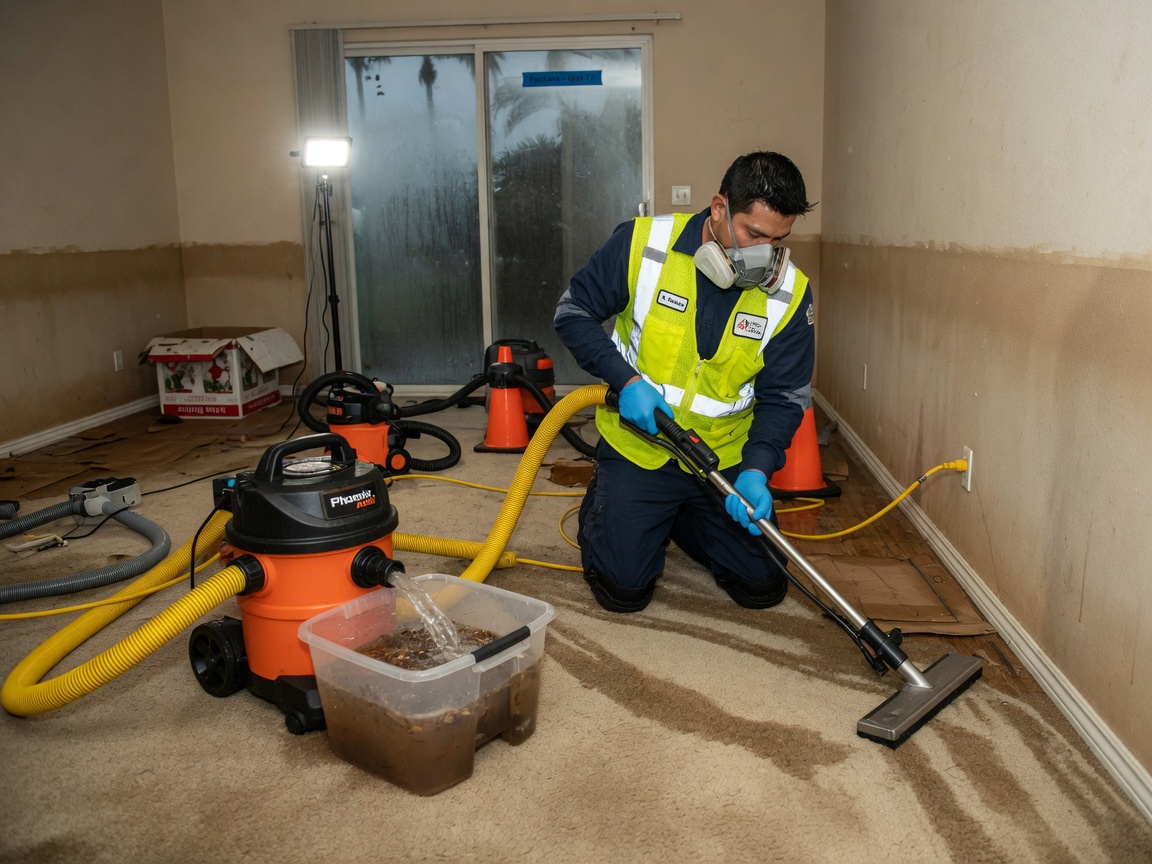
Fontana’s hot-summer Mediterranean climate means standing water in a home can turn into a mold problem within 24–48 hours once temperatures climb above 90 degrees. Older tract homes built in the 1960s and 1970s around Downtown Fontana and South Fontana often have slab-on-grade foundations with limited under-slab drainage, so water that reaches the subfloor stays trapped against the soil. Technicians must pull carpet, remove baseboards and use moisture meters on the concrete before any drying equipment is placed, or hidden moisture will migrate into drywall and cabinets.
North Fontana neighborhoods near the Auto Club Speedway sit on slightly higher ground but still see water intrusion from roof penetrations during rare but intense winter rains. When extraction crews arrive they first isolate electrical circuits because many of these homes still have original aluminum wiring that corrodes quickly once wet. Submersible pumps handle the bulk removal, followed by truck-mounted extractors on carpet and pad; any delay lets water wick into the particleboard underlayment common in homes built before 1990.
San Bernardino County code requires proper disposal of extracted water when sewage or gray water is involved, so crews carry containment barrels and document volumes for the property owner. Nearby cities like Rialto and Rancho Cucamonga share the same soil and housing stock, so the same extraction sequence applies when calls cross city lines. The address at 6188 N Kingsmill Ct allows 24-hour dispatch that reaches most of Fontana within 45 minutes even during rush hour on the 210.
Technician insight
In Fontana the thing that catches most people out with Emergency Water Extraction is the hardpan clay soil under South Fontana slabs; water pools against the concrete and travels under walls into adjacent rooms before homeowners notice, so we always check the garage and laundry room even when the leak started in the kitchen.
South Fontana Slab Leak
Water from a failed supply line under a 1972 tract home reached the living room slab. Extraction crews found moisture had wicked 18 inches up the drywall and into the adjacent hallway. After pump-out and pad removal, drying equipment ran for 72 hours until meter readings matched the unaffected bedrooms.
Emergency Water Extraction Services We Offer
✓Standing Water Pump-Out
Removes inches of floodwater from slabs and basements using submersible pumps before secondary damage spreads through stucco walls common in South Fontana.
✓Carpet and Pad Extraction
Pulls saturated carpet and underlayment in one pass with truck-mounted units to prevent mold growth in older North Fontana tract homes.
✓Appliance Leak Water Removal
Extracts water from washing machine, water heater or refrigerator leaks before it reaches particleboard subfloors typical in 1970s Fontana construction.
✓Sewage Backup Extraction
Handles contaminated water removal with containment and disposal compliant with San Bernardino County health requirements.
✓Roof Leak Extraction
Removes water that has entered through compromised roofs after winter storms, protecting ceilings in Downtown Fontana bungalows.
Emergency Water Extraction Cost in Fontana, CA
| Service | Typical Range | What Affects It |
|---|---|---|
| Initial Assessment | Free | Applies when extraction work follows |
| Standing Water Extraction | $450–$900 | Depends on depth and square footage in slab homes |
| Carpet And Pad Removal | $1.25–$2.50 per sq ft | Higher in homes with glued-down carpet |
| Equipment Drying Per Day | $150–$300 | Based on number of air movers and dehumidifiers needed |
| Sewage Containment And Disposal | $350–$650 | Required for black water in San Bernardino County |
Ranges are typical for Fontana, CA and confirmed with an exact written quote before any work starts.
How it works
- 1
On-Site Assessment
Technician arrives within the hour, maps water migration with moisture meters and identifies affected materials in slab homes.
- 2
Water Removal
Submersible pumps and extractors pull standing water and lift carpet and pad for disposal or off-site drying.
- 3
Containment And Drying Setup
Air movers and dehumidifiers are placed while electrical circuits are isolated and affected rooms are sealed from the rest of the house.
- 4
Final Moisture Verification
Readings are taken on concrete and framing until levels match unaffected areas before equipment is removed.
Pricing
Upfront quotes provided after assessment; cost driven by water volume, affected square footage and whether sewage is present.